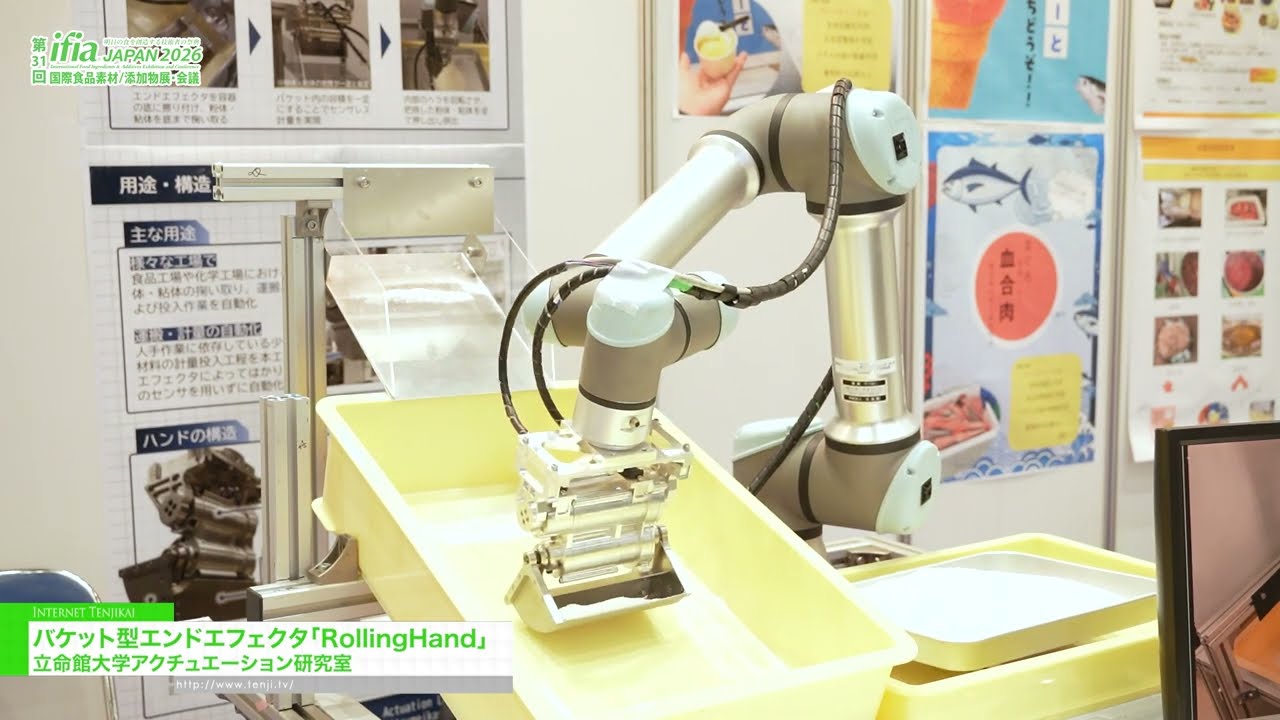
Ritsumeikan University’s Kakogawa Laboratory is developing robotic hand technology to automate powder feeding processes in the food and chemical industries.
Manufacturing sites still rely heavily on manual work for measuring and feeding powdered raw materials, making it difficult to achieve both labor saving and consistent quantitative supply.
The laboratory has developed an end effector based on a flexible rolling hand structure that can scoop material from the bottom of a container while quickly grasping a fixed amount, aiming to improve automation efficiency in food factories.
Challenges Addressed
Target Customers
FAQ
What are the features of the Rolling Hand?
What applications is it designed for?
How does it differ from conventional methods?
View Video Transcript
This is the Kakogawa Laboratory at Ritsumeikan University.
We have developed an end effector called the Rolling Hand, which is the hand part of a robot designed to grasp fixed amounts of powders and similar materials in the food industry, and I would like to introduce it.
Currently, in processes where raw materials such as powders are fed in the food and chemical industries, much of the work still depends on human labor, so we want to automate those operations.
One feature of this system is that it can scoop material all the way from the bottom of a container filled with powder.
With conventional industrial robots, contact with objects is considered dangerous and is generally avoided as much as possible, but the hand we developed has flexibility, allowing it to scoop material from the bottom of the container.
Another feature is that it can grasp a fixed amount. By limiting the volume inside this bucket-shaped case and adding a leveling motion from above, we developed this end effector, or robot hand, inspired by the way humans use teaspoons or tablespoons.
The idea is to scoop material, level it off, take a fixed amount, and feed it into processing equipment.
With this approach, compared with systems that often use weighing equipment for quantitative measurement, the operation can be completed more quickly.
We are currently working with a venture company that uses systems like this to measure raw materials for shipment, and we are continuing development toward commercialization.
If you are interested in this technology or initiative, please visit the website of the Kakogawa Laboratory at Ritsumeikan University’s Actuation Laboratory, where you can find contact information.
Thank you very much.
Contact Us

Ritsumeikan University Kakogawa Laboratory
Available Languages
◇
Thinking of Exhibiting?
From exhibition video streaming to booth design & build and domestic or overseas trade shows — World Trade Show.tv is here to support you. Contact us here.

About the Exhibition