Touki Co., Ltd. provides organic food ingredients from China to food manufacturers and OEM businesses.
In the food ingredient market, increasing demand for health-oriented and organic ingredients has created challenges related to stable sourcing and securing differentiated raw materials.
The company introduces a wide range of ingredients handled by its subsidiary, Sichuan Xiangzhen Enterprise Co., Ltd., including yuzu, acai, noni, matcha, jujube, Sichuan pepper, wasabi, sesame, and cordyceps. These ingredients are proposed for applications in beverages, confectionery, seasonings, and health foods. By leveraging its sourcing and processing network for organic ingredients in China, the company expands options for product development and industrial ingredient supply.
Challenges Addressed
Target Customers
FAQ
What are the main organic ingredients introduced by Touki?
What forms of jujube ingredients are available?
What applications are suggested for matcha ingredients?
View Video Transcript
Our company was established in Osaka about 33 years ago and has been based there ever since. However, what I would like to bring attention to is our subsidiary, Sichuan Xiangzhen Enterprise Co., Ltd..
Sichuan Xiangzhen manufactures various food products in China, and all of them are organic.
We have brought some of these products with us today,
but what I would especially like to recommend this time is the wide variety of organic ingredients available in China.
I would like to introduce them to you.
The products are in separate locations, so I would like to guide you through them as you go.
In this booth, we have yuzu. This is the yuzu that is famous in the Tokushima and Kochi prefectures.
We have brought yuzu and yuzu peel from the company that produces it.
And over here we have acai ingredients.
In Japan, there is currently a shortage of acai ingredients, but in China, they are cultivated on Hainan Island
and also imported and processed like this.
This is noni. I don’t think it’s very familiar to people in Japan, but in China and Southeast Asia, it’s attracting a lot of attention as a healthy food.
This is noni powder.
At this booth, we have tea and jujubes.
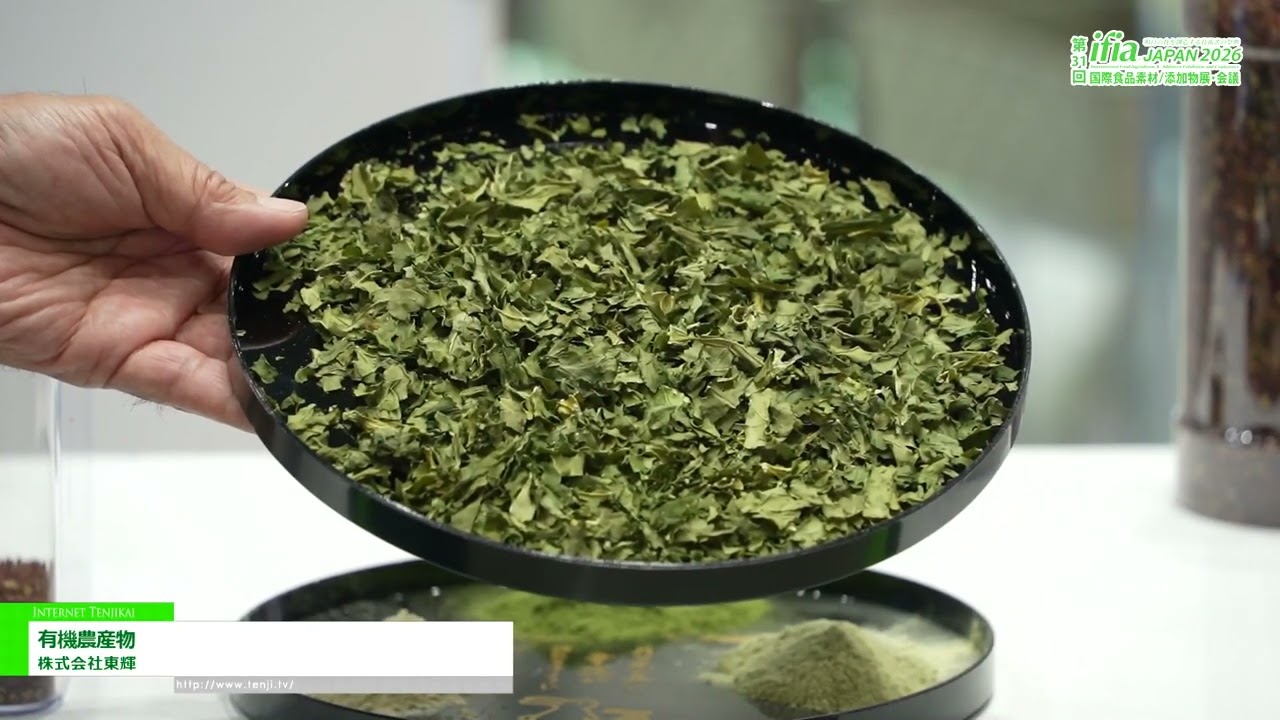
This tea is different from the tea that people in Japan drink; it’s matcha, the kind used in various matcha ice creams, matcha sponge cakes, and so on.
This is the raw material.
This comes from the Zhejiang Province in China.
This is the matcha powder made from it,
and these are 1A, 2A, 3A, 4A, and 5A.
There are various ways to use this, whether for commercial use or by dissolving it in water and drinking it, so please try them out.
In this corner, we will be focusing on jujubes.
As you all know, these are jujubes,
but there are two types: those with seeds inside and those with the seeds removed.
And this is a liquid syrup made from those jujubes.
I think this will be used as a sugar substitute in the future.
These jujubes are organic. We expect they will also be obtaining organic JAS certification this October.
We also have extracts.
So, if you have any questions about jujubes, we can handle them at this booth.
In this corner, we are selling Sichuan peppercorns.
Sichuan peppercorns are famous for their numbing spiciness, especially in Sichuan hot pot.
This time we have brought these Sichuan peppercorns directly from their place of origin to Tokyo.
Let me introduce you to our wasabi.
The root, stem, and leaves of wasabi are, in principle, used for food.
This is the powdered version.
This is the root powder.
The root is the thickest part of the wasabi plant.
This is the stem powder.
This beautiful colored powder is made from wasabi leaves.
By mixing these three types and adding horseradish, the spiciness of wasabi comes out.
This dried wasabi leaf has the most beautiful color.
If you don’t use this, the wasabi will turn a grayish color like this.
This is the natural color of wasabi.
By using the leaves, the green color of the wasabi comes out. This is the current situation.
Now, let me introduce you to the bounty of the sea and the mountains.
These are freeze-dried matsutake mushrooms.
These are freeze-dried truffles.
This is the porcini mushroom, which is familiar to people in Japan.
Next to it, we also have organic nori seaweed.
This comes in various sizes, large and small, so please contact us and we will provide you with what suits your needs.
Now, this is sesame.
I have been working with organic sesame since 2004.
The final form of this is pressed sesame oil.
The usual method of pressing oil is to apply heat.
That has been the method until now.
This is the color.
This one is pressed while frozen.
We have things like that.
The color and aroma are completely different. This is a product that I would like you to try.
Next we have sesame paste.
This is white sesame paste that I have brought with me this time.
This year, there is a shortage of black sesame seeds. Therefore, we are currently only recommending our white sesame seeds.
We also handle the raw materials for white sesame seeds.
Finally, I would like to explain several products at once.
Originally, Sichuan Xiangzhen, a subsidiary of TOUKI, dealt in herbal medicine.
In connection with that, we also bring in cordyceps.
And then there are the snacks.
These snacks use mixed grains and the various spices I mentioned earlier.
These are matcha cookies.
Sichuan Souzhen also processes and sells these kinds of products.
However, currently, we only sell these products within China.
In the future, once we have increased our production capacity a little more, we are considering selling outside of China as well.
At the same time, as I mentioned earlier regarding tea, we have been asked by our tea sellers if we can produce these tea whisks in China, and TOUKI is now handling that as well.
In particular, we make whisks that can be branded to your liking, so please feel free to contact us anytime if you are interested.
Contact Us

Touki Co., Ltd.
◇
Thinking of Exhibiting?
From exhibition video streaming to booth design & build and domestic or overseas trade shows — World Trade Show.tv is here to support you. Contact us here.

About the Exhibition