

What is Maintenance Resilience TOKYO? | Japan’s Trade Show for Plant Maintenance, Infrastructure Inspection and Disaster-Resilient Technologies

What is Maintenance Resilience TOKYO? | Japan’s Trade Show for Plant Maintenance, Infrastructure Inspection and Disaster-Resilient Technologies
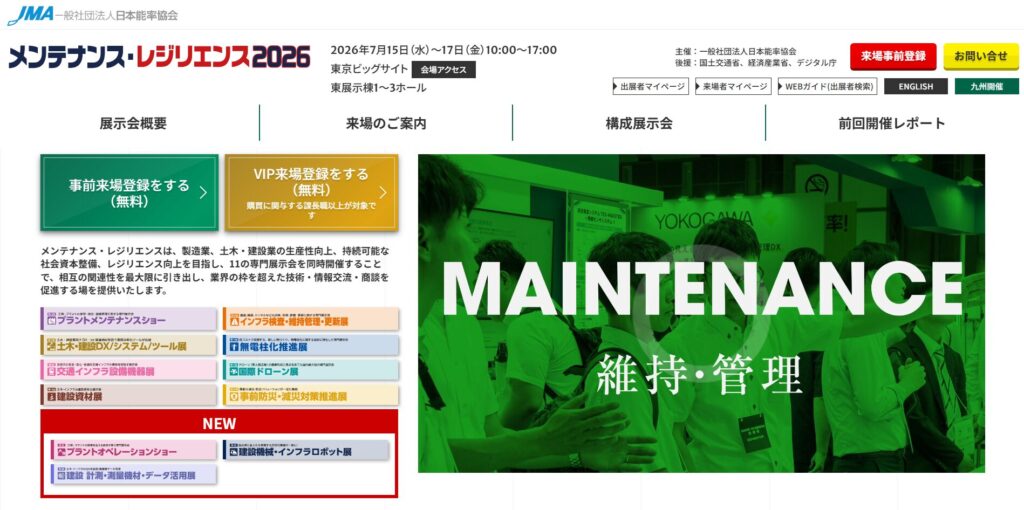
Maintenance Resilience TOKYO is a B2B trade show focused on productivity improvement, sustainable social infrastructure, maintenance technologies, infrastructure inspection, disaster prevention, construction DX, and resilience-related solutions for manufacturing, construction, transportation, utilities, public infrastructure, and local government sectors.
The event brings together technologies and services for plant maintenance, infrastructure inspection and renewal, plant operation, civil engineering and construction DX, utility pole-free urban development, transportation infrastructure, drones, construction materials, disaster risk reduction, construction machinery, infrastructure robots, surveying, measurement, and data utilization.
As Japan faces aging production facilities, labor shortages, aging workers, aging bridges, roads, tunnels, plants and public infrastructure, as well as growing natural disaster risks, Maintenance Resilience TOKYO serves as a practical business platform where engineers, maintenance managers, facility managers, construction companies, infrastructure operators, public-sector officials and technology suppliers can exchange technical information and conduct business negotiations.
What is Maintenance Resilience TOKYO?
A Trade Show Covering Maintenance and Resilience Across Industry and Infrastructure
Maintenance Resilience TOKYO is a specialized exhibition that covers both “maintenance,” such as the upkeep and preservation of production facilities and infrastructure, and “resilience,” meaning the ability of organizations, systems and infrastructure to respond to risks, recover from disruption and maintain continuity.
A Cross-Industry Platform for Manufacturing, Construction and Public Infrastructure
The exhibition is designed to connect technology providers with users in manufacturing, construction, transportation, lifeline infrastructure, plant operation, civil engineering, municipalities and public agencies. It provides a venue for business discussions and technical information exchange across fields that are often managed separately but share common challenges in maintenance, inspection, safety and risk response.
Event Overview
Latest Event Information
| Event Name | Maintenance Resilience TOKYO 2026 |
|---|---|
| Dates | July 15–17, 2026 |
| Opening Hours | 10:00 a.m.–5:00 p.m. |
| Venue | Tokyo Big Sight, East Exhibition Hall |
| Organizer | Japan Management Association |
| Format | B2B trade show for maintenance, infrastructure, construction and resilience technologies |
| Admission | Visitor registration required |
Event Scale, Attendance and Exhibitor Numbers
Latest Planned Scale
- Expected exhibitors: about 390 companies
- Expected booths: about 760 booths
- Expected visitors: about 40,000 including concurrent exhibitions
- Specialized exhibitions within Maintenance Resilience: 11
Maintenance Resilience TOKYO is a large-scale B2B exhibition that brings together a wide range of technologies related to maintenance, infrastructure inspection, disaster prevention, construction, plant operation and social infrastructure resilience. Visitors use the event to compare inspection technologies, maintenance systems, construction solutions, DX tools, drones, measuring equipment and risk-response technologies in one venue.
Recent Event Results
| Year | Exhibitors / Booths | Visitors | Key Notes |
|---|---|---|---|
| 2025 | 455 exhibitors / 903 booths | 32,392 visitors including concurrent exhibitions | Strong interest was seen in DX, IoT-based maintenance, equipment monitoring and drone-based infrastructure inspection |
| 2026 | About 390 exhibitors / 760 booths expected | About 40,000 visitors expected including concurrent exhibitions | Scheduled to be held at Tokyo Big Sight East Exhibition Hall |
Exhibition Categories
Main Product and Technology Categories
- Plant maintenance technologies and services
- Infrastructure inspection, maintenance and renewal technologies
- Plant operation and O&M solutions
- Civil engineering and construction DX systems and tools
- Technologies for utility pole-free urban development
- Transportation infrastructure equipment and systems
- Industrial drones and unmanned aerial systems
- Construction materials and infrastructure materials
- Disaster prevention and disaster risk reduction solutions
- Construction machinery and infrastructure robots
- Measurement, surveying and data utilization for construction and infrastructure
- Non-destructive inspection, sensing and monitoring technologies
- Equipment diagnosis, predictive maintenance and facility management systems
- Safety, labor-saving and productivity improvement solutions
Specialized Exhibitions
- Plant Maintenance Show
- Infrastructure Inspection, Maintenance and Renewal Exhibition
- Plant Operation Show
- Civil Engineering and Construction DX / Systems / Tools Exhibition
- Utility Pole-Free Promotion Exhibition
- Transportation Infrastructure Equipment Exhibition
- International Drone Exhibition
- Construction Materials Exhibition
- Disaster Prevention and Mitigation Promotion Exhibition
- Construction Machinery and Infrastructure Robot Exhibition
- Construction Measurement, Surveying Equipment and Data Utilization Exhibition
Market Developments and Key Trends
1. Aging Facilities and the Need for Predictive Maintenance
Manufacturing plants, utilities, roads, bridges, tunnels and other infrastructure assets require more advanced maintenance as aging progresses. Technologies such as sensors, remote monitoring, AI-based diagnosis, condition monitoring, vibration analysis and predictive maintenance systems are becoming important for reducing downtime and preventing accidents.
2. Labor Shortages and Skills Transfer
Maintenance and construction sites face labor shortages and the retirement of experienced workers. Digital manuals, remote support tools, inspection robots, drones, AI-based image analysis and maintenance management systems are being introduced to support work efficiency and pass technical knowledge to younger workers.
3. Infrastructure Inspection Using Drones and Robotics
Drones and robots are increasingly used for inspecting bridges, tunnels, plants, elevated structures, roofs, slopes, power facilities and other locations that are difficult or dangerous for workers to access. These technologies can help improve safety, reduce inspection time and collect visual data for long-term asset management.
4. Construction and Infrastructure DX
The use of digital tools in construction and civil engineering is accelerating. BIM/CIM, 3D measurement, surveying data, cloud-based project management, digital twins, remote monitoring and data platforms are being adopted to improve productivity and decision-making across infrastructure projects.
5. Disaster Prevention, Risk Response and National Resilience
Heavy rain, earthquakes, typhoons, landslides and heat-related risks are major concerns for infrastructure operators, manufacturers, municipalities and construction companies. Disaster prevention, mitigation, emergency response, business continuity and infrastructure resilience are therefore important themes at the exhibition.
6. Decarbonization, Energy Efficiency and Sustainable Infrastructure
Maintenance and infrastructure projects are increasingly expected to balance safety, productivity and environmental responsibility. Energy-saving equipment, long-life materials, efficient repair methods, low-carbon construction machinery and sustainable infrastructure management are becoming important topics.
Visitor Profiles and Business Needs
Key Visitor Groups
- Manufacturing plant managers and maintenance departments
- Facility management and production engineering teams
- Construction companies and civil engineering contractors
- Infrastructure operators for roads, bridges, tunnels and transportation systems
- Public agencies and local governments
- Plant engineering and plant operation companies
- Railway, airport, port and transportation infrastructure organizations
- Utility, energy and lifeline infrastructure companies
- Inspection, measurement and surveying professionals
- Disaster prevention, safety and risk management departments
Primary Reasons for Attending
- Finding maintenance technologies for aging facilities and infrastructure
- Comparing inspection, measurement, monitoring and diagnostic solutions
- Introducing drones, robots and remote inspection tools
- Improving productivity and reducing labor requirements at work sites
- Strengthening disaster prevention, BCP and infrastructure resilience
- Promoting DX in construction, civil engineering and facility management
- Finding new suppliers, contractors and technology partners
Many visitors to Maintenance Resilience TOKYO come with practical operational challenges. This makes the exhibition suitable for technical demonstrations, case-study presentations, equipment comparisons, supplier evaluation and concrete business negotiations.
Key Features of Maintenance Resilience TOKYO
1. Coverage from Production Facilities to Social Infrastructure
The exhibition covers not only plant maintenance and factory equipment management, but also roads, bridges, tunnels, transportation infrastructure, disaster prevention, civil engineering and construction technologies. This wide scope makes it possible to compare maintenance and resilience solutions across multiple industries.
2. Strong Match with Maintenance, Construction and Infrastructure Users
The event attracts professionals responsible for facility maintenance, infrastructure management, construction, inspection, safety, disaster prevention, and production continuity. Exhibitors can therefore reach users who are directly involved in solving maintenance and infrastructure challenges.
3. Practical Demonstrations and Technical Information Exchange
Because the exhibition focuses on field-oriented technologies, demonstrations of inspection equipment, drones, sensors, software, robots, construction machinery and monitoring systems are highly effective. Visitors can evaluate practical usability, safety, accuracy and implementation conditions directly at the booth.
Frequently Asked Questions
Can members of the public attend Maintenance Resilience TOKYO?
Maintenance Resilience TOKYO is a B2B trade show intended for professionals in manufacturing, construction, infrastructure, maintenance, disaster prevention, transportation, utilities and related industries. Visitor registration is required.
What kinds of products and technologies are exhibited?
Exhibits include plant maintenance technologies, infrastructure inspection tools, non-destructive inspection systems, drones, robots, measuring instruments, construction DX tools, disaster prevention solutions, construction machinery, facility management systems, monitoring technologies and maintenance services.
What types of companies should consider exhibiting?
The event is suitable for suppliers of inspection equipment, sensors, maintenance systems, drones, robots, construction machinery, facility management software, disaster prevention products, infrastructure materials, construction DX tools, plant O&M services, safety products and resilience-related solutions.
Is the event suitable for overseas companies?
Yes. Overseas companies offering maintenance, inspection, infrastructure, disaster prevention, plant operation, construction or digital solutions can use the event to approach Japanese manufacturers, construction companies, infrastructure operators, public agencies and engineering firms.
Can exhibitors conduct live demonstrations?
Yes. Demonstrations are especially effective because many visitors evaluate technologies based on real field use. Exhibitors should prepare equipment demos, videos, case studies, sample data and application examples that clearly show how the technology improves safety, productivity, inspection accuracy or resilience.
Watch Exhibitor Videos
Featured Exhibitions by Year
Benefits of Exhibiting
Maintenance Resilience TOKYO is a B2B trade show where professionals from manufacturing, construction, infrastructure, public works, transportation, utilities and disaster prevention gather to compare technologies for maintenance, inspection, renewal, safety and resilience.
For exhibitors, the main advantage is the ability to meet visitors who are directly responsible for solving practical operational issues. These issues include aging facilities, infrastructure deterioration, labor shortages, disaster risks, inspection efficiency, equipment monitoring, maintenance cost reduction, construction productivity and business continuity.
Because the exhibition covers both industrial facilities and social infrastructure, exhibitors can approach a wide range of target users, including plant maintenance teams, facility managers, construction companies, civil engineering contractors, infrastructure operators, local governments and engineering firms.
Preparation Points for Exhibitors
Many visitors to Maintenance Resilience TOKYO are engineers, maintenance managers, inspection specialists, infrastructure managers, construction professionals, safety managers and public-sector officials. Exhibitors therefore need to communicate both technical credibility and field-level usefulness.
Instead of simply displaying a product, exhibitors should explain where the technology is used, what problem it solves, how it improves safety or productivity, and what implementation conditions are required.
- Clarify the target field, such as plant maintenance, infrastructure inspection, construction DX, disaster prevention or facility management
- Prepare demonstrations, inspection samples, measurement data, case studies and before-and-after examples
- Show how the solution reduces inspection time, improves safety, supports labor saving or strengthens resilience
- Organize technical specifications, installation requirements, applicable structures and maintenance conditions
- Use a two- to three-minute exhibition video to explain field applications, workflows and implementation benefits
Maintenance and infrastructure technologies often require detailed explanation. Exhibition videos are useful for showing inspection procedures, drone operation, robot movement, sensor installation, monitoring screens, disaster prevention applications and actual field use cases. They can help visitors understand technologies that are difficult to demonstrate fully inside the booth.
Estimated Exhibiting Costs
Booth Space Fees
Booth space fees vary depending on the exhibition plan, booth type, application timing, booth location and the organizer’s latest exhibitor package. Companies considering participation should confirm the official exhibitor brochure for the current fee structure.
A one-booth exhibit can be suitable for presenting a focused technology, inspection device, sensor, software product, material, tool or service. Companies that need to display large equipment, drones, robots, construction machinery, demonstration areas or meeting spaces may require two or more booths.
For maintenance and infrastructure exhibitions, booth planning should account not only for display space but also for demonstration space, power supply, safety lines, sample storage, meeting tables, equipment operation, visitor flow and transportation routes.
Booth Design and Construction Costs
Booth construction costs vary depending on whether the exhibitor uses a basic booth, an optional decoration plan, a modular booth or a custom-built booth. The organizer provides optional booth decoration plans, while additional equipment such as chairs, tables, lighting and monitor screens may be rented separately.
- Basic decoration plan: approximately JPY 164,560 per booth
- Premium decoration plan: approximately JPY 369,792 per booth
- Custom decoration plan: quotation required depending on booth size and requirements
- Large machinery, drones, robots, live demonstrations or equipment operation may require additional costs
At Maintenance Resilience TOKYO, visitors often evaluate technologies from a practical field perspective. Booth design should make it easy to understand what the technology does, where it is used and what benefits it provides. Large monitors, LED displays, inspection samples, process diagrams, demonstration counters and exhibition videos can help communicate technical value clearly.
Staffing Costs
A one-booth exhibit typically requires around two to four staff members, while larger booths may require engineers, sales staff, product specialists, demonstration operators, interpreters and meeting coordinators. For maintenance and infrastructure exhibitions, it is especially important to have staff who can answer detailed questions about specifications, applicable structures, inspection methods, installation conditions, safety requirements, delivery time, maintenance, pricing and return on investment.
Since visitors may come from different fields, such as plants, civil engineering, public infrastructure, construction, local government or utilities, staff roles should be assigned in advance. Sales staff can handle initial conversations, engineers can explain technical details, and senior staff can join discussions about project requirements, procurement conditions or field implementation.
Transportation and Logistics Costs
Exhibits may include drones, robots, inspection devices, measuring instruments, sensors, monitoring systems, construction materials, safety equipment, tools, control panels, catalogs, demonstration units and display fixtures. These items may require careful packing, transportation, installation and safety management.
If heavy equipment, large structures, drones, robots or precision instruments are displayed, exhibitors should plan logistics early, including delivery route, unloading method, electricity requirements, internet connection, floor load, storage space, safety covers and setup schedule. Spare parts, tools, batteries, cables, consumables and backup devices should also be prepared to prevent interruptions during demonstrations.
Booth Examples by Size
One-Booth Exhibit
A one-booth exhibit is suitable for presenting a focused product, device, sensor, software solution, material or service. In a limited space, exhibitors should avoid overloading the booth with too many messages. A clear headline, product sample, inspection example, process diagram and short video can help visitors quickly understand the solution.
This format is suitable for first-time exhibitors, inspection equipment suppliers, sensor manufacturers, software vendors, maintenance service providers, materials companies and specialized technology providers.
Two-Booth Exhibit
A two-booth exhibit allows exhibitors to separate the demonstration area from the business meeting area. It is suitable for companies that need to show equipment operation, compare inspection samples, display monitoring screens, demonstrate drone or robot applications, or present several product categories.
For example, one side can be used for demonstrations and product displays, while the other side can be used for technical discussions, quotation consultations and follow-up meeting arrangements. Combining a live demonstration with an explanatory video can help communicate both field performance and business value.
Four or More Booths
A booth with four or more spaces is suitable for companies presenting large equipment, infrastructure robots, construction machinery, drone demonstrations, multiple product zones, maintenance systems or several brands. Larger booths can include demonstration stages, private meeting rooms, storage areas, reception counters and large video displays.
This format is effective for companies that need to attract visitors from a distance, run scheduled presentations, handle multiple business meetings at the same time, or communicate complex solution portfolios for plant maintenance, infrastructure inspection and disaster resilience.
Key Elements of a Successful Exhibition Booth
Visitor Flow
Visitors at Maintenance Resilience TOKYO often arrive with specific operational challenges. The booth should clearly indicate the target application, industry and problem solved from the aisle. A successful layout guides visitors from a quick first impression to product understanding, demonstration viewing, technical discussion and business negotiation.
For equipment demonstrations, it is important to separate the viewing area from the meeting area so that crowds do not block business discussions or safety zones. If drones, robots or moving equipment are shown, safety lines, explanation panels and staff placement should be planned carefully.
Visibility
- Large signage showing the target field, such as plant maintenance, infrastructure inspection, disaster prevention or construction DX
- Clear labels indicating the problem solved, such as aging facilities, inspection efficiency, labor saving, safety or BCP
- Demonstration screens, inspection samples and process diagrams
- Large monitors or LED screens for videos and case studies
- Keywords such as predictive maintenance, drones, robots, sensors, DX, IoT, disaster prevention, resilience and safety
Even at a highly technical trade show, visitors need to understand the booth concept within a few seconds. Clear signage and visual communication are especially important when the technology is complex or when multiple exhibitors offer similar inspection, maintenance or monitoring solutions.
Demonstrations and Hands-On Experiences
Live demonstrations are highly effective at Maintenance Resilience TOKYO because visitors often evaluate technologies based on actual usability, safety, reliability, accuracy and field applicability. Exhibitors should prepare demonstrations that show inspection procedures, measurement results, drone footage, robot movement, monitoring dashboards, before-and-after improvements, disaster response scenarios or maintenance workflows.
When full-scale demonstrations are difficult, exhibitors can use sample structures, damaged material samples, inspection images, simulation videos, touchscreens, data dashboards and comparison panels. The goal is to help visitors understand not only the product features but also how the technology will improve their own site operations.
Using Exhibition Videos
Exhibition videos are useful for explaining maintenance and infrastructure technologies in a short time. A two- to three-minute video can summarize the product concept, target application, field workflow, installation example, inspection process, customer case study and measurable benefits.
Videos are particularly effective for technologies that are difficult to demonstrate fully inside the booth, such as bridge inspection, tunnel inspection, plant shutdown maintenance, drone surveying, remote monitoring, AI-based diagnosis, disaster prevention systems, construction DX and large-scale equipment operation.
When shown on a large monitor or LED screen, video content can attract visitors from the aisle and communicate the solution even when staff members are already engaged in discussions. For overseas visitors, English subtitles or multilingual versions can improve communication and create smoother business opportunities.
Videos recorded during the exhibition can also be used after the event in sales presentations, email follow-ups, social media, exhibition landing pages, online catalogs and Internet Exhibition.tv. This turns a three-day exhibition into a longer-term marketing asset.
Visitor Acquisition Strategies for Better Exhibition Results
Email Marketing
Before the event, exhibitors should send invitation emails to existing customers, prospects, distributors, agents, infrastructure operators, facility managers, maintenance departments, construction companies, public-sector contacts and past exhibition leads. The email should clearly include the booth number, featured products, demonstration schedule, available consultation topics, appointment booking method and downloadable materials.
In maintenance, infrastructure and construction sectors, many visitors plan their schedule around specific technologies and business meetings. Early outreach can increase the number of qualified appointments and improve booth traffic.
Social Media
LinkedIn, X, YouTube and industry media channels can be used to share demonstration previews, product videos, technical explanations, booth setup progress and seminar announcements. Maintenance and infrastructure audiences respond well to practical content such as case studies, before-and-after improvements, field application examples, inspection footage and short technical videos.
Social media posts should connect the exhibition theme with specific operational challenges, such as aging infrastructure, inspection efficiency, labor saving, safety improvement, disaster prevention, BCP, DX, IoT, predictive maintenance and drone utilization.
Invitations and Direct Mail
Printed invitations, direct mail, catalogs and sample-based mailings can be effective for priority customers and key accounts. For maintenance and infrastructure buyers, physical materials such as technical brochures, inspection reports, comparison tables, case studies and application guides can make the invitation more memorable.
The invitation should clearly explain what visitors can see, test, compare or discuss at the booth. It should also include the booth number, contact person, meeting reservation method and any scheduled demonstrations.
Exhibition Landing Pages
A dedicated exhibition landing page can support lead generation before and after the event. The page should include the exhibition overview, booth location, featured products, demonstration schedule, technical documents, case studies, exhibition videos, appointment form and inquiry form.
By directing visitors from email, social media, advertisements and direct mail to the landing page, exhibitors can help prospects understand the offering before visiting the booth. After the event, the landing page can continue to function as a sales resource for leads who attended the show and prospects who could not visit in person.
Request a Booth Contractor Recommendation and Receive a Free Exhibitor Video Package
Submit your requirements and our team will recommend suitable contractors.
Looking for a booth design and construction company for this exhibition?
Tell us about your project and requirements.
Our team will review your request and introduce suitable contractors.
As a special benefit, exhibitors who request quotations through our service will receive a complimentary exhibitor video production package.
Your request is not automatically sent to all contractors. We carefully review your requirements and connect you with the most suitable companies.